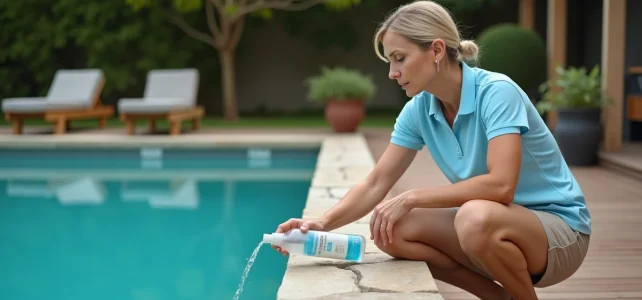
Mixing a clarifier and chlorine in the same pool raises a question of chemical compatibility that manufacturers’ instructions rarely address in detail. The clarifier agglomerates suspended microparticles to facilitate their capture by the filter, while chlorine ensures disinfection. Using both at the same time is possible, but dosage conditions, the type of polymer, and the pH of the water radically change the outcome.
Cationic or anionic polymers: real compatibility with chlorine
Commercial clarifiers rely on two families of polymers. Cationic polymers (positive charge) attract negatively charged fine particles and agglomerate them into filterable flakes. Anionic polymers work in the opposite way.
Further reading : Can you really have two rental leases at the same time in France?
According to a case study by Bayrol France, presented during the “Maintenance 2026” webinar broadcast on April 12, 2026, cationic polymer-based clarifiers used with stabilized chlorine significantly reduce filter clogging. In contrast, traditional anionic polymers do not provide the same benefit in the presence of stabilized chlorine.
This distinction changes the game for anyone looking to use clarifier and chlorine at the same time in Maison Future Co without degrading filtration. Before purchasing a clarifier, checking the nature of the polymer on the label becomes a more useful reflex than comparing prices per liter.
See also : Tips and Inspiration for Creating a Flowering and Harmonious Garden at Home
| Criteria | Cationic clarifier + stabilized chlorine | Anionic clarifier + stabilized chlorine |
|---|---|---|
| Filter clogging | Reduced | Comparable or increased |
| Clarification speed | Fast (dense flakes, well captured) | Slower (light flakes, possible passage) |
| Salt electrolysis compatibility | Good (effervescent tablets recommended) | Variable depending on formulation |
| Polymer residues after filtration | Low if dosage is respected | Higher in case of overdose |
Accumulation of polymer residues and skin irritations in regular bathers
A pool treated with chlorine continuously and clarified regularly accumulates polymer residues if the filtration does not completely eliminate them. For occasional use (cloudy water after a storm, spring restart), the risk remains marginal.
The problem arises in regular bathers exposed over several months. Residual polymers combined with free chlorine can promote chronic skin irritations, particularly in people with sensitive skin or children. Chlorine partially oxidizes certain polymers, generating by-products that remain in the water until the filter captures them.
Minimizing this risk involves three concrete levers:
- Strictly adhere to the dosage indicated by the clarifier manufacturer, without doubling the dose to speed up clarification
- Rinse or clean the filter in the hours following the addition of the clarifier, to remove flakes loaded with polymers
- Space out clarifying treatments by at least two weeks and do not make it a systematic weekly maintenance gesture
The clarifier remains a corrective product, not a routine maintenance product. Using it at every swim indicates an upstream problem: unbalanced pH, insufficient filtration time, or too high organic load.
Effervescent tablets for saltwater pools: an underestimated format
Pools equipped with a salt electrolyzer produce their own chlorine. Adding a liquid clarifier in this context can disrupt the electrolysis cell if the product alters the water’s conductivity.
Effervescent clarifier tablets bypass this problem. Their gradual dissolution releases the polymer evenly, without a localized concentration spike near the cell. Electrolytic chlorine continues to be produced normally.
This format is not well promoted by retailers, who prefer liquid clarifier containers (higher margin, faster consumption). For a saltwater pool, the tablet represents a better compromise between clarification and preservation of the disinfection system.
European labeling and chlorine-clarifier compatibility
Since January 2026, a European regulatory evolution requires manufacturers to provide mandatory labeling of chlorine-clarifier compatibilities on packaging. This measure follows consumer complaints about opaque formulations, where nothing indicated whether the clarifier could be added to already chlorinated water.
Checking this mention on the bottle before purchase avoids unpleasant surprises: product precipitation, persistent cloudy water, or partial neutralization of free chlorine.
Natural enzymatic flocculants: a compatible alternative with chlorine
The recent trend of natural enzymatic flocculants offers a pathway for those who want to clarify without adding synthetic polymers. These products use enzymes that break down organic matter (sunscreen oils, sweat, plant residues) before they cloud the water.
Their main advantage: no known negative interaction with chlorine. They do not generate flakes to filter, but eliminate the cause of the cloudiness rather than its symptoms. Classic filtration is then sufficient to maintain clarity.
Their limitation lies in their ineffectiveness against mineral particles (suspended lime, oxidized iron). For cloudy water of mineral origin, polymer-based clarifiers remain the suitable solution.
Chlorine-clarifier dosage: thresholds not to be exceeded
The pH conditions the effectiveness of both products. A clarifier works optimally within a pH range of 7.2 to 7.6, which is also the ideal range for chlorine. Going outside this range reduces the action of both products simultaneously.
The order of addition also matters. Adjust the pH, then add chlorine, then wait for the filtration to circulate the water for a few hours before introducing the clarifier. Pouring both products at the same time into the skimmer concentrates the reactants and can cause localized precipitation that clogs the pump’s pre-filter.
- Measure the pH and correct it if necessary before any intervention
- Add chlorine (or initiate a shock chlorine treatment if the water is green) and let filter for at least four hours
- Introduce the clarifier by spreading it over the surface, filtration running
- Clean the filter the next day to remove accumulated flakes
A pool where the pH, filtration time, and organic matter load are controlled only needs a clarifier a few times per season. If the use of the clarifier becomes frequent, the issue to explore is almost always an undersized filtration time or a clogged filter that allows fine particles to pass through.