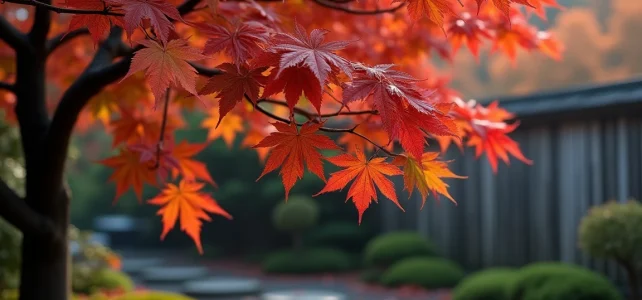
Your Japanese maple is losing its leaves in the middle of summer, sometimes even in spring, and the sight has nothing to do with autumn colors. The leaves dry at the edges, curl up, and then fall all at once. This phenomenon affects both Acer palmatum in the ground and those grown in pots, and the causes often overlap.
Japanese maple in a pot: a special case that traps many gardeners
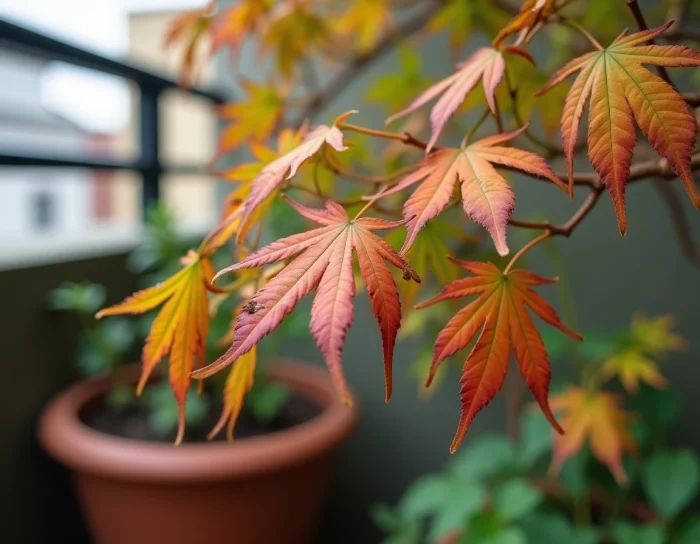
Competitors rarely talk about pot cultivation, yet this is precisely where most problems arise. A Japanese maple in the ground has a sufficient root volume to buffer temperature and humidity fluctuations. In a pot, this margin does not exist.
Read also : How to Find the Ideal Home Online: Tips and Tricks for Success
The substrate in a medium-sized container can go from waterlogged to dry in a single hot day. This water yo-yo causes a root shock that triggers leaf drop well before autumn. Watering more does not solve anything if the substrate has become compacted or if the roots are spiraling at the bottom of the pot.
Have you noticed that the leaves always scorch on the same side? It is often the side exposed to the afternoon sun. A pot placed on a south-facing terrace accumulates heat through its walls, and the peripheral roots literally cook. Moving the pot to the shade of an east-facing wall is sometimes enough to stop the leaf drop within a few days.
See also : How to Prevent Grass from Sticking Under the Mower: Effective Solutions and Tips
A common phenomenon involves the Japanese maple losing its leaves suddenly after repotting or relocating. The tree reacts to stress by shedding its foliage to limit evaporation. This survival mechanism is temporary, provided that the growing conditions are stabilized.
Soil, exposure, and water: the trio that determines leaf retention
The Japanese maple thrives in a cool, slightly acidic, and well-drained soil. Heavy, clayey soil retains water around the roots and promotes root asphyxiation. Conversely, sandy soil dries out too quickly. The compromise lies in a mix of heather soil, compost, and a draining material.
Exposure: not too much sun, not too much shade
Most varieties of Acer palmatum prefer a semi-shaded exposure, facing north or east. Direct afternoon sun burns the leaves, especially in regions with hot summers. Too much shade is also a problem: the foliage dulls and the shrub weakens.
A good indicator: if the leaves dry at the edges progressing towards the center, the sun is likely the cause. If the foliage pales uniformly without scorching, it is more likely a lack of light.
Watering: regularity rather than quantity
The most common mistake is to drown the tree after noticing the damage. Regular and moderate watering is better than a compensatory deluge. Mulching at the base of the shrub (pine bark, dead leaves, flax straw) keeps the soil cool and limits evaporation.
- Water in the morning rather than in the evening to avoid stagnant nighttime moisture on the superficial roots.
- Check the soil moisture a few centimeters deep before watering: the surface may seem dry while the substrate underneath is still moist.
- During heatwaves, thick mulching significantly reduces the need for watering and protects the roots from direct heat.
Verticillium wilt of the Japanese maple: recognizing and reacting to this fungus
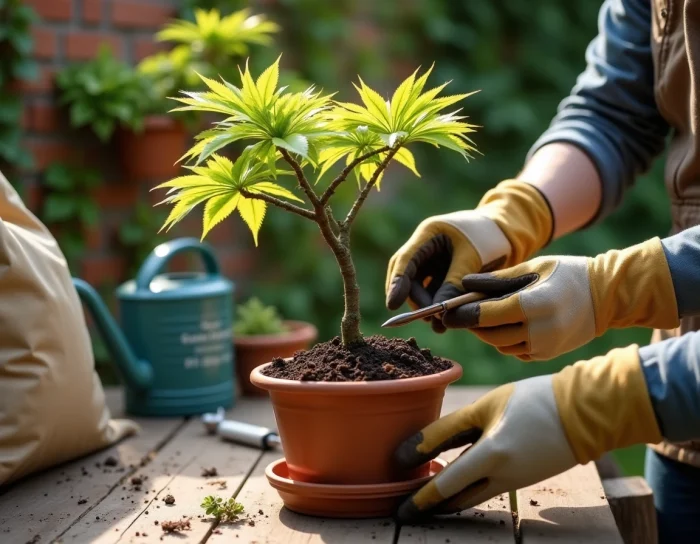
When leaf drop is accompanied by a sudden wilting of entire branches, verticillium wilt should be considered. This soil fungus (Verticillium) blocks the sap-conducting vessels. The tree can no longer nourish its branches, and entire sections die within weeks.
The field diagnosis is accessible: cut a affected branch and observe the section. Brown-olive streaks in the wood confirm the presence of the fungus. The leaves do not dry out uniformly as they would in a heat shock. Here, some branches die while others remain green.
There is no effective curative treatment for verticillium wilt. Useful actions aim to limit its spread:
- Remove affected branches by cutting well below the contaminated area, and disinfect your tools between each cut.
- Improve soil drainage to reduce moisture favorable to the fungus.
- Do not replant a Japanese maple in the same location after a confirmed case of verticillium wilt, as the fungus persists in the soil.
- Add an organic amendment to stimulate soil biological activity, which helps the tree to better resist.
Pruning the Japanese maple: an action that can worsen leaf drop
Faced with a bare maple, the reflex to prune to “revive” the vegetation is tempting. This is often counterproductive. Acer palmatum does not tolerate severe pruning well, and late pruning in late winter coincides with sap rise, causing leaks and weakening the tree.
The right time is in late autumn when the shrub is dormant. Limit yourself to removing dead wood and crossing branches. A light pruning is enough to aerate the canopy without traumatizing the tissues.
If your maple is losing its leaves due to water stress or unsuitable exposure, pruning will not solve anything. First, correct the environment (shade, watering, mulching) before touching the branches. The tree will regrow on its own the following season if the conditions are met.
Leaf loss in a Japanese maple always tells something specific about its environment. Rather than multiplying interventions, observe the location of the damage on the shrub: leaves burned on one side, entire wilting branches, or uniform discoloration. Each symptom points to a different cause, and the appropriate response is rarely the same.