Under the neon lights of Maghreb cities or in the shade of family living rooms, one word makes an appearance every evening during Ramadan and leaves no one indifferent: “saha ftourek.” Simple in appearance, this greeting conceals a mosaic of responses that reveals much more than mere politeness; it is an art of living, sometimes even a rivalry of phrases.
The response to “saha ftourek” varies according to regions, habits, and the way social ties are perceived. For some, simply saying “barakallahou fik” is enough. Others find the phrase too short and prefer to add a wish for health or family. The result: diversity prevails, and behind the uniformity of the ritual, each family, each circle, cultivates its own codes.
Linguists have observed that the way of responding is not fixed. It adapts to age, closeness, and the time of the meal. A teenager will respond differently than an elder; a table of friends will not use the same words as an exchange between neighbors. These variations, far from being anecdotal, sometimes lead to small mishaps, spontaneous corrections, and remind us that tradition remains alive because it reinvents itself.
Why “saha ftourek” resonates so strongly during Ramadan
In the Maghreb, the expression saha ftourek is an obvious choice at the breaking of the fast. It transcends generations, carried by family and community. Ramadan is not just a month of deprivation. Through this simple phrase, it becomes a month of sharing, solidarity, and kindness. Saying “saha ftourek” acknowledges the effort, salutes the patience of the one who has abstained from eating and drinking from dawn until sunset, echoing the tradition of fasting in Islam.
The meaning of saha ftourek extends far beyond the religious act. It symbolizes a cultural custom of the Arab world, inseparable from the daily life of Muslims during Ramadan, in Morocco as well as in Algeria, Tunisia, or the diaspora. The phrase, passed down from generation to generation, is not a formal prescription of religion. It stands as a mark of cordiality, a gesture of belonging that unites the group.
This cultural richness is reflected in the diversity of usages. Some will respond with a simple “barak Allahu fik”, while others will choose a more personal reply. The real challenge is to understand how to respond to saha ftourek to honor the exchange, preserve the warmth of social ties, and perpetuate the tradition. The question, far from being trivial, touches on the intimate nature of transmission, on what makes the strength of Ramadan in the Maghreb countries and well beyond.
What responses to choose to honor this tradition?
Saying saha ftourek during Ramadan is a custom as deeply rooted in the Maghreb as it is meaningful. But the response, far from being automatic, conveys recognition and reciprocity. Depending on the context or closeness, several phrases are available, each rooted in the oral tradition of the Arab world.
Here are the most frequently exchanged responses according to families and moments:
- Allah ybarek fik: May God bless you. A phrase full of respect that values the gesture of the other.
- Barak Allahu fik: Same message, different wording. Common in family conversations and among friends.
- Allah ysahhikom: May Allah grant you health. A mark of attention focused on well-being.
- Ftourkoum mabrouk: May your breaking of the fast be blessed. The emphasis here is on the shared moment.
- Saha ou raha: Health and rest. More familiar, it finds its place in intimate or casual exchanges.
None of these phrases come from a religious text. They are practices forged by daily life and community solidarity. While the Muslim tradition refers to a specific invocation at the breaking of the fast, “The thirst is gone, the veins are moistened, the reward is assured, if Allah wills,” reality prefers these direct exchanges, imbued with respect and attention, at the heart of iftar gatherings.

Concrete examples to respond with respect and warmth
At the moment of iftar, the phrase “saha ftourek” circulates from one corner of the table to another, sometimes whispered, sometimes shouted out loud. It is family, neighbors, friends passing by, or community strangers wishing each other a peaceful breaking of the fast. The response is never a mere formality: it carries gratitude, respect, and recognition of the shared effort.
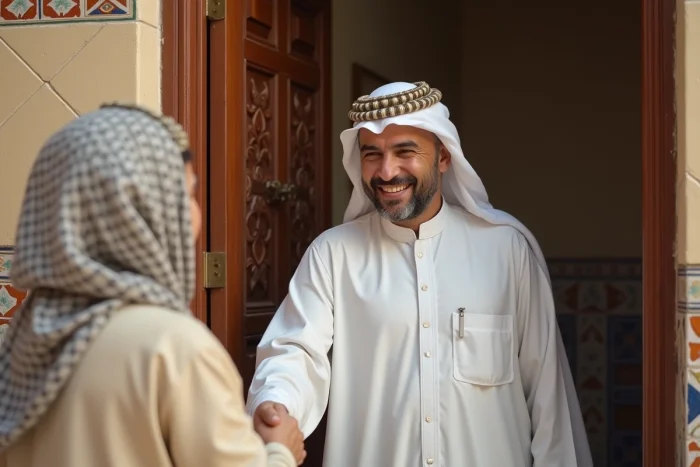
Imagine an ordinary scene: the mother places the chorba, the father busies himself with the dattes, the children hold back their hunger while watching for sunset. A guest says “saha ftourek,” the host replies “Allah ybarek fik” or, depending on the closeness, “saha ou raha.” At the mosque, during a shared meal, “saha ftourkoum” sometimes elicits “ftourkoum mabrouk” in return, to bless the moment.
Sometimes, around the table, some discover these customs. In that case, translating the phrase is enough: “Happy breaking of the fast” or “May this meal bring you strength and blessing.” The exact expression matters less than the sincerity behind it. The key element remains the warmth of the exchange and the respect for the effort made. These words, inherited from Maghreb culture, remind us that Ramadan is above all a time of brotherhood, where every gesture counts.
When the sun sets and the table comes alive, these phrases do more than fill a silence: they weave, from one word to another, the invisible thread of a community united around a shared hope.